Dispatch notes: How to build a world
or On the (difficulty of) constructing a conceptual framework for my dissertation

Dear Reader,
This is a piece about me making peace with not knowing the story yet. It is a journal entry that I have cleaned up for public consumption. I wanted to share a little more of the behind-the-scenes thinking which goes into a dissertation, because it is often hard to recount this to someone who hasn’t experienced it before. This is the kind of stuff that you will never find in a dissertation, unless the person was doing an auto-ethnography on their metacognition, or something like that.
Most of the time people talk this through, whether with themselves or someone else. The process becomes ephemeral. But in writing about and thinking through it the way that I do here, (some aspect of) my process becomes a record that speaks for itself.
If you're in the middle of something that feels unfinished and wrong, this is for you.
Enjoy!
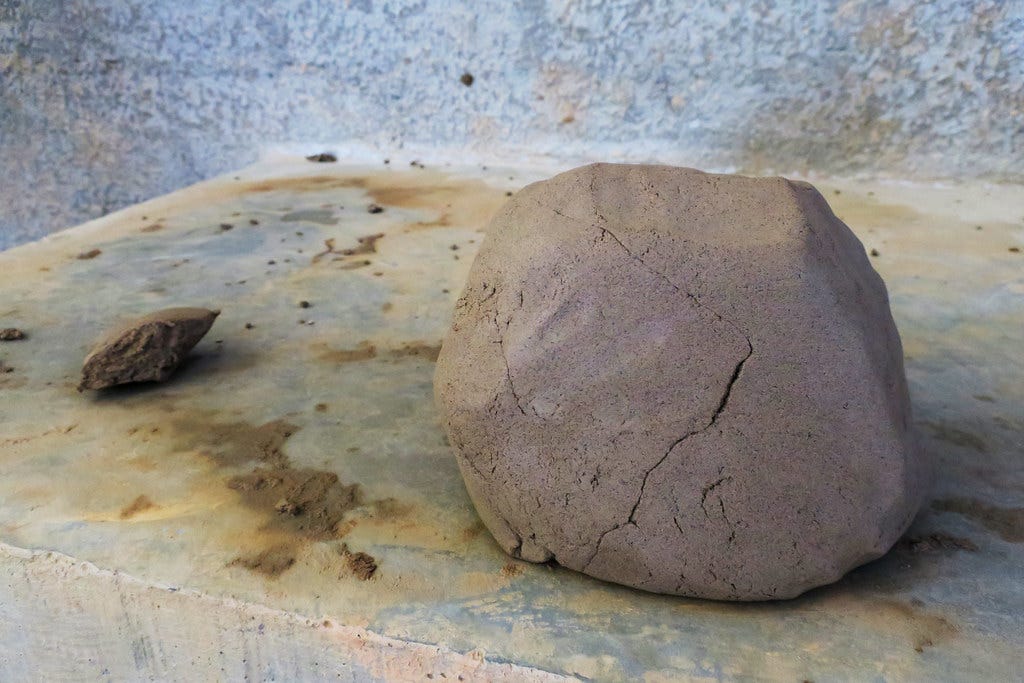
“The sculpture is already complete within the marble block, before I start my work. It is already there, I just have to chisel away the superfluous material.”
― Michelangelo
Daily Writing-07152026
I have been struggling to figure out how to arrange my conceptual framework chapter so that it makes sense.
I have already accepted that it is going to be a long chapter. No need to lie to myself about my truth: I am a yapper. That when it comes to conceptual framework, I might very well have to go all the way to establishing that we are not seeing the world in the exact same way no matter what. But that’s okay, if I let it be okay.
So, I choose to let “long and dense” be acceptable.
Still, I—my intuition?—can’t help but feel that how I choose to lead the reader along is going to be more important than the sheer volume of words. But how? What does it even mean to “lead the reader along”? What if they don’t wanna come along?

What if they actively ignore what I said to make me defend myself against claims I didn’t make? Fuck, it sucks so much when people force me to do this. And the worst part is that it happens all the time. I just feel I am doomed—

One fun fact about me: I have programmed myself to activate my sleeper agent whenever I get to the level of talking about “I am doomed.” Maybe I could install it earlier, but we don’t have time to psychoanalyze. The main point is that when I reach this point, I almost automatically enter into diagnostic mode.
This is what diagnostic mode is like:
Shutting off all non-essential functions.
Noticing breath patterns.
Recalling water consumption relative to system needs.
Checking the time to see how long the system has been powered on, and dedicated CPU to current task.
Acknowledging the flippant comment bug that the system “ignored” earlier, even though data printout shows that it actually continued to interrupt smooth functioning through the day.
Reading previous system status reports—AKA listening to the narrative that I have constructed about what is happening.
Asking the system to provide an immediate answer to “if there were no consequences, would you choose to continue the thing that you’re currently doing?”
It’s quite brilliant, if I do say so myself. And I do 🤗
My inner monologue at this point: Breathe, Akua. The outcome of this deliberation—how you will lead the reader along—is not life or death, even though it feels that way in your system.
And don’t do that thing where you repackage your panic on another level by deciding to feel silly about the fact that you’re letting a non-life or death situation feel like it is, in fact, life or death. It is all okay.
Deep breaths. Inhale for 5, 4, 3, 2, 1.
Exhale for 7, 6, 5, 4, 3, 2, 1.
That’s it, keep it up.
Everything really has to be prime numbers, huh? [chuckles at myself] The way I insist on prime numbers, you would think that it was actually life or death!
Isn’t it funny how I can make anything life or death?
But also, I can insist on something without making it life or death! Like, it’s not like I demand that everyone else only show me prime numbers all the time. It’s just a fun thing I do.
So I can hold on to helpful bits, and release not-so-helpful bits. I can hold on to the desire to write a good story—I am but an artiste, after all! I wanna feel good about my shit!—and release the demand to answer all of these “how”/“what if” questions on the spot.
The things that are out of my control don’t have to occupy space in my thinking. Besides, those potential outcomes drop down to exactly zero if I don’t finish writing the thing that they may or may not ignore!!! They can’t misunderstand me if I don’t provide them something to misunderstand lol.
I should focus on what is in my control.
Okay, here’s the good news: I have the bits. The components. Most of them, at least. I need to read the Halbwachs stuff about collective memory, but with most of the other books and articles I just need to go back to my proposal, preliminary exam papers, or back to the notes I took on them. [I started panicking a little over the volume of stuff, and what I might do in every possible circumstance, which is why I had to provide myself with the reassurance that no matter what, I’ll be okay.] And if I read something in my notes which doesn’t make sense to me, I will just go back to the article or book.
That’s a great place to be! It would be so much worse if I didn’t have the bits AND I didn’t have the story.
The story of this chapter is like a Lego structure, except I decide what it is. I’m worried about it, but I don’t even know what I want. So let’s name what I want, at the level that it is available to me.
And I want it to be clear. Elegant.
Yes, even if it is long and dense. I can dream, okay?!
It will not be universally liked, obviously.
But I dream that anyone who doesn’t have some kind of cognitive block preventing them from viewing my art-qua-dissertation with clear perception, can at the very least read it and be able to appreciate where the work is coming from.
I need to remember to limit the epistemological musings in this chapter. No “What can we know?” or “How do we come to know?” or “What is the nature of truth and belief?” But I’m sure it will become necessary later. Maybe in one of the discussion or conclusion chapters?
From my prelims:
The conceptual or theoretical framework is “a set of interrelated constructs, definitions, and propositions that presents a systematic view of phenomena by specifying relations” among constructs (Kerlinger, 1979, as cited in Creswell & Creswell, 2023, p. 102). Theories in qualitative social science research can be deductive in that they can explain and hypothesize about the social phenomena of interest, but they can also be inductive, using specific observations to identify broader themes and construct “a generalized model or theory” (Creswell & Creswell, 2023, p. 102). An appropriately constructed conceptual framework helps researchers organize their thoughts, define key concepts, establish relationships between variables or ideas, and develop a methodological approach for data collection and analysis (Zuberi & Bonilla-Silva, 2008).
Ignoring the grammatical errors, I have great news: I do have most definitions done, relationships too (except for Halbwachs and Gramsci re collective will+intellectuals, which honestly might reorganize the whole thing, but that’s okay. I will figure it out as I write.
Methodological approach: I kinda wanna say that this is more about setting things up such that when I move on to the next chapter in which I explain my methods, it makes sense within my conceptual framework. This is where I often mix up practices (methods), justification for practices, and how I am making sense of these practices (methodology). But wait…I kinda laid that out cleanly 😏 Maybe I’m not as mixed up as I thought!
And honestly now that I think about it, there’s low-key a natural order to this list of things that an appropriately constructed framework should help me do. One that started with organizing my thoughts. So I am exactly where I am meant to be! See, things are much better than I thought 😁
So yeah, the story is the organizing. The blueprint. The game plan. The execution sequence. The arc of my narrative.
Since I can’t figure it out on a “what’s the specific story I want this chapter to tell” just yet, let me go back to basics: is there an order to arranging things which feels logical to me?
Not really, but maybe if I refresh my mind on the previous chapter, the things I want to cover in this one, and what comes next, it might help?
Okay so, I spent Chapter One telling the story of how this dissertation came to be. It is the story of the dissertation’s creation.
This chapter is the world-building. The thing about world-building is that it’s not neutral. The things that I choose to notice are significant, because I deem them so. So it’s not just “here are some aspects of this world; do with it what you will.” It’s more like “this world tells this story, and in sharing that with you I reveal aspects of this world.” There must be a through-line that I recognize on some level, even if I cannot articulate it just yet. It’s that whole “I don’t know what I’m looking for, but I’ll know it when I see it” thing.
Which means: start off with general overview of that broad story, why that should matter to the reader, and then a roadmap of how that story will unfold.
It’s the kind of story which begins at the end, but not working backwards or something like Memento. It’s like there’s some aspect of the narrator (me), from the future where things are already resolved, returning in time to the reader who is on the precipice of jumping in—but has no idea what to expect and is therefore entering more defensively than they might need to—and saying “hey. I know I am about to ask for your time and attention on this journey. But I promise you it’s going to pay off. And here’s why. I am not going to lie to you: there will be rough patches. Tensions. Moments when it’s not exactly clear where this is going. But it is. And you can take me at my word because I’m telling you precisely what the plot of the story is. So…what are you waiting for? Hop in!”
Because it is not about building up suspense and mystery, per se. It’s about providing a bird’s eye view. Sharing the flight plan, so that at any point the passenger can look at the status thing and know if we are still on track or if we have detoured.
LMFAO I love me an analogy!
So yeah, that’s what I still need to figure out. But maybe I should re-read my old stuff and see if the story emerges organically? Well, I should also read the Halbwachs stuff and the additional Gramsci stuff since it’s quite salient in this whole construction.
LOL no wonder I was struggling with this! I don’t even have the information I need to tell my story!
What a relief, to realize that there’s nothing wrong with me.
That I am exactly where I should be.
I think I already know how I want this chapter to end, right before I transition to methods.
It feels like it should end with me basically explaining why the movie and Clark are worth studying. In the introduction I told more of the personal reason this dissertation topic made sense to me. And while I do acknowledge+gesture to it, I do not substantively explain the non-personal things there. Which is totally okay…for that chapter.
But in this second chapter, I provide my conceptual framework so that the reader and I can both look at the cited scholarship+evidence, along with my interpretation of said material, and agree that my use of those works is valid. Not because the reader would necessarily do things the same way, but because it’s reasoned out well. They may not even agree with it—oftentimes not because I’m wrong but because due to some factor, my reasoning was poorly communicated OR poorly received—but they can understand where I am coming from.”
Not only that, but if I have done my work well, they will also feel excited to keep going with me.
I know they say “the best dissertation is a done dissertation,” and I agree with that, but I refuse to believe that that means I have to compromise on what “done” means to me. Because for me, it doesn’t mean that I have covered every single angle that could potentially be covered in the spectrum of possibilities of potential dissertations on my topic.
For me, a done dissertation is when I can see—in my mind’s eye—sufficient alignment between the version of me telling the story, and the version of me receiving it.
That’s not an unreasonable goal for me, personally. I am not giving myself an impossible task to justify further procrastination. I am desiring something that I already feel routinely, when I allow myself free expression. I even felt it when I finished this draft of Chapter One.
In fact, it is what is motivating me to continue writing.
There is, more often than not, something about what others reflect back to me which feels like it is not quite aligned with my intended projection.
But me? I get me.
I really like myself as my own audience. And not just because I think everyone should be their own biggest fan. I am also really good at taking myself at face-value, and refusing to complete sentences/thoughts/concepts that are only half-baked when expressed in writing.
I’m sure there’s something that I am going to miss, but that’s why we ask for external feedback! Eventually.
This stage? This is a me-versus-me moment.
If I cannot impress me, if I cannot feel confident with what I am sending out for external feedback, then any feedback I receive will have to go through my newly-constructed internal barrier of lower confidence. And that makes it less efficient.
Because barriers like that one are going to filter out potentially useful feedback, if the barrier deems such feedback a threat to its integrity.
I don’t have to feel less confident because I don’t know what I am trying to say. I could decide to find confidence in the fact that I don’t know what I am trying to write.
And if I do get to the point where I feel I need to talk to someone else about this, I can rest assured that I have people that I can turn to. Which I am so deeply grateful for, now and always.
Right now, though? This is good tension. It is a lovely experience on every level that I can perceive to toy around with the story. To hold, inspect, toss against the wall, torch with a flame, chop into bits, mold, polish, primp. Eventually to present.
A dark night of the soul is not something to avoid or worry about, if you know how to navigate it.
Back into the abyss I go!