Going with the flow...literally!
A lesson in creativity from Homer, and Christopher Nolan

I really enjoyed Christopher Nolan’s “The Odyssey,” if my tweets are anything to go by.
This is in huge part because of the film’s technical and narrative mastery, but it also struck a personal chord and helped me break through a self-imposed cognitive block that has impeded my writing for the last few months. For the entirety of my dissertation career, if I am being honest with myself.
My biggest stumbling block has been my conceptual framework, specifically.
The conceptual framework is the big idea that holds your entire dissertation together. I like to think of it as the map you provide your readers with before they start the journey into your work, a framework that saves them from experiencing the same odyssey (!) you underwent to draw the map in the first place.
For months, every time I tried to draw it, I felt paralyzed.
Not because I didn’t have ideas. No, that has never been my struggle. If anything, I had too many!
But I couldn’t figure out where to start. My dissertation is about a specific film, in a specific sociopolitical context, so it felt to me that my conceptual framework should likewise be granular, focused, and manageable. But every time I sat down to write, I felt drawn toward explaining why stories matter in the first place. And that simply felt too general.
So I would stop myself from exploring that path. However, I then found that I couldn’t get myself to just start writing about some other aspect of the conceptual framework. If I pushed myself too far, I would eventually panic and try to justify everything related to that other concept. Only to eventually end up right back at why stories matter.
I will provide an example. Let’s say I want to talk about Hollywood’s role as a propaganda machine. I might ask when Hollywood started, who started it, and why. Why does Hollywood’s work matter so much? For each of these questions, “story” is a concept that shows up repeatedly as I attempt to construct an answer. “When” is a classic start to a story, so immediately I think of the question “when did Hollywood start” another part of my brain flags my awareness to the fact that we have entered “story mode.” This means that as I am finding answers to some of these questions, my brain is attempting to find connections between ideas, arrange them in some sequential structure, reconcile (or at least acknowledge) complimentary and contradicting information, identify subjects along with their motives, actions, consequences, etc. etc.
And that’s just for this simple set of questions! To get a sense of what was going on in my head, multiply whatever you imagine this to feel like by like every single concept you can think of related to “Joe Clark Paterson New Jersey Lean on Me Biopic Integration Black Educational Leadership”.
Yeah, it was rough.
But the thing is, every single one of the topics which came to mind eventually led me right back to the thing that I was avoiding exploring.

I was at a standstill. It was as if I couldn’t take a single step without first laying down the entire pavement from here to the horizon. That felt too overwhelming, but I also refused to accept the invitation I felt to explore why stories matter. And so I never moved at all. I just kept staring at the distance, overwhelmed by the gap between the sweeping and the specific.
Do you ever find yourself looking back on life, only to realize that the solution to your problems had been present all along? But that you had ignored or dismissed it as inconsequential? I know I feel that all the time.
Because here’s the thing: I wasn’t wrong to want to start there. Stories do matter. A lot. More than I was giving myself credit for. Everything is a story—even what I “see” is a result of my brain telling stories about its sense-perceptions. When the light hits my retina, my neurons fire in response, and through a still-abstruse process of sense-making, my mind translates the experience in the form of a narrative constructed of that “raw” (knowing that technically there’s no way to distinguish “raw” from “translated”) data. Basically, I don’t encounter the world directly. I encounter the story my brain tells me about the world.
So in actuality, starting with stories wasn’t me being frivolous. I was just being honest about how I—and everyone else, for that matter—actually experience reality.
I can recognize this now, but I might not have gotten there if I hadn’t watched Odysseus finally return to Ithaca.
One of the (many) modifications that Christopher Nolan made for his movie adaptation of “The Odyssey” is that Odysseus finally returns to his beloved Ithaca because he stopped resisting. He released the urge to control his raft amidst the tempest, and allowed Poseidon’s rage to take him wherever the god pleased.
And wouldn’t you know it, he wakes up exactly where he had been aiming!! The place that remained far out of his reach every time he used might and will to move forward, but which appeared as if by magic when he went with the flow—literally!!!
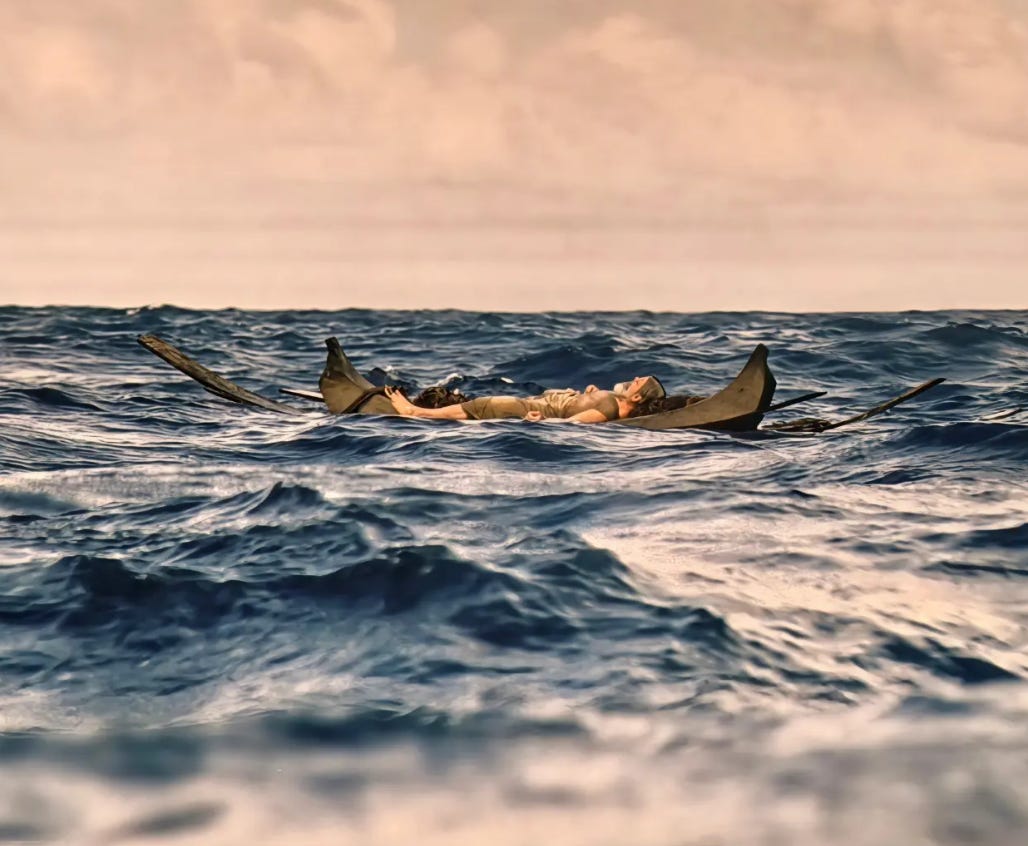
In the epic, The Phaieacians finally release him from his dreamlike captivity that they have termed hospitality, and deposit him on the shores of Ithaca while he is still asleep.
These scenes touched me deeply, because I saw so many moments in my life when my attempts to jury-rig my success only led to more catastrophe, when I only made it out of the tempest by releasing my impulse to fight what is.
I have been struggling with my conceptual framework because I have been struggling AGAINST myself.
So what if I want to start at that most general level? So what if it sends me on an unexpected path? The journey from Troy to their homes was a straightforward journey for “all the others who had not been killed in the war,” but for Odysseus it included multiple side-quests.
I cannot use my starting point to extrapolate my finish line, because the beginning does not determine the middle and it definitely does not determine the end.
Technically, everything between Troy and Ithaca happens in the astral/dream world.
What if, like Odysseus, I keep my end goal in mind at all times, but also allow my mind to wander as it sees fit? I can think of each island as its own detour, which allows me to metabolize the knowledge and experiences that I have accrued over the almost-decade that I have been engaging in doctoral studies.
Because I really am on a journey back to self. Remembering who I am, what I care about, what my purpose is.
Writing is an instrument for navigating this journey, but I do not know what the full process is going to look like until I just...start.
I guess, unlike Odysseus, I do not have gods who are rooting for my success, who can help me get back on track when I am led astray or when I forget my purpose.
But wait! Who is to say that I do not have my own “gods” rooting for me? Expanding the notion of gods to include things like practical wisdom and good judgement, the struggle with “divine” guidance is that you do not necessarily know when they are going to show up. If they are even going to show up.
I may not have Athena, but I have something close. I’m going to call her My Gut Instinct. She is the one who interrupts my defensive meandering and says, No, this way. You were talking about stories. Go back there.
The hard part isn’t hearing her. It’s trusting her. Trusting that things will unfold as they need to.
Eventually, parts of this writing will belong in the final draft of my dissertation. There are most definitely parts of Odysseus’s journey which he considered too banal, or too extraneous to be included in his narration to the Phaeacians.
We don’t ever hear him discuss how they managed to deal with bodily excretions when they were in the wooden horse, for example (I have…questions). But that doesn’t mean it didn’t happen. The audience doesn’t have to know those gory details, so they are excised from the final narrative.
I can apply this logic my conceptual framework. I have to let myself figuratively release my bowels LMFAO.
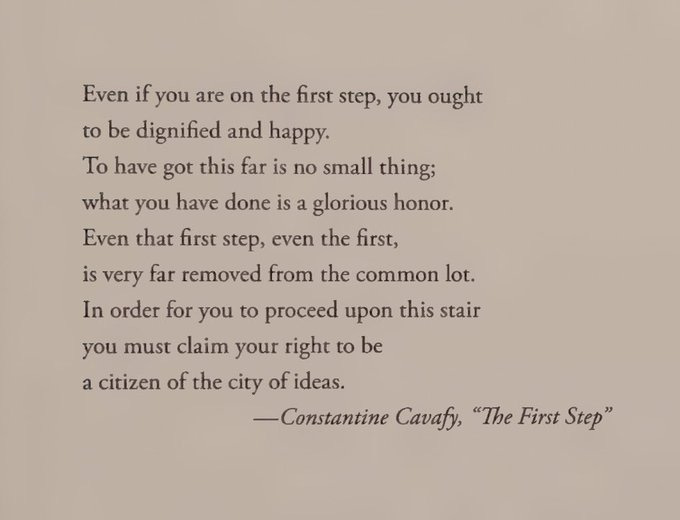
The journey to the city of ideas begins with one small step.
For now, I am just figuring out what I want to say. Not HOW I want to say it.
I know plagiarism happens, and on the level I care about it is still relevant. But I don’t think the “is this plagiarism” detector belongs anywhere near the brainstorming phase. It is part of the “Editor” package, which should only be used in full once I allow myself the space to imagine at my own pace.
Which means: releasing my yapper side from the shackles that I imposed on them. I think I justified self-restraint by referring to my tendency to over-explain, which ends up losing people rhetorically. But when I think about it, I don’t think my over-explaining and my yapping have much to do with one another!! You see, my yapper side is actually quite clear. They talk a lot, for sure. But not because they are providing clarification. Only because it brings them joy to express that way.
So the analogies, metaphors, connections to other things I’ve watched or read or thought or listened to or felt are welcome in the brainstorming stage. The editor will figure out, later, which ones (if any) to keep for an externally oriented piece.
But the “and I am not saying that-” or “I can imagine that someone would think that-” or attempts to anticipate and address any possible pushback? I’ll do without as much as possible when brainstorming, unless it feels absolutely necessary to my yapping.
How will I know the difference? Because such clarifications will not send me on a detour which leaves me feeling frustrated at the audience that I made up in my head, who (by my own orchestration) “refuses” to understand me. The right kinds of clarifications will feel like a delicious aside in a play, before I return to the actual plot. Any additional qualifiers will be determined by The Editor when it is their turn to hold the reins, and maybe based on feedback from others.
Ughhhhh but what if I still end up getting distracted and demoralized, even at the brainstorming stage?
Then I let it happen. I notice it happening, recall the thoughts and feelings I was having right before I made the decision to hedge my comments, and redirect back to actual writing. Not gonna beat myself up about that, because that’s an easy way to guarantee that I will keep over explaining LMFAO.
All I need to do is act, even if I can only see just a few feet ahead of me.
What’s your version of the conceptual framework? What is something that you keep overthinking before you even start? I would love to know how you talk yourself down from that ledge!