Who Gets to Think?
From Descartes's Method to Gramsci's Creative School

I lied.
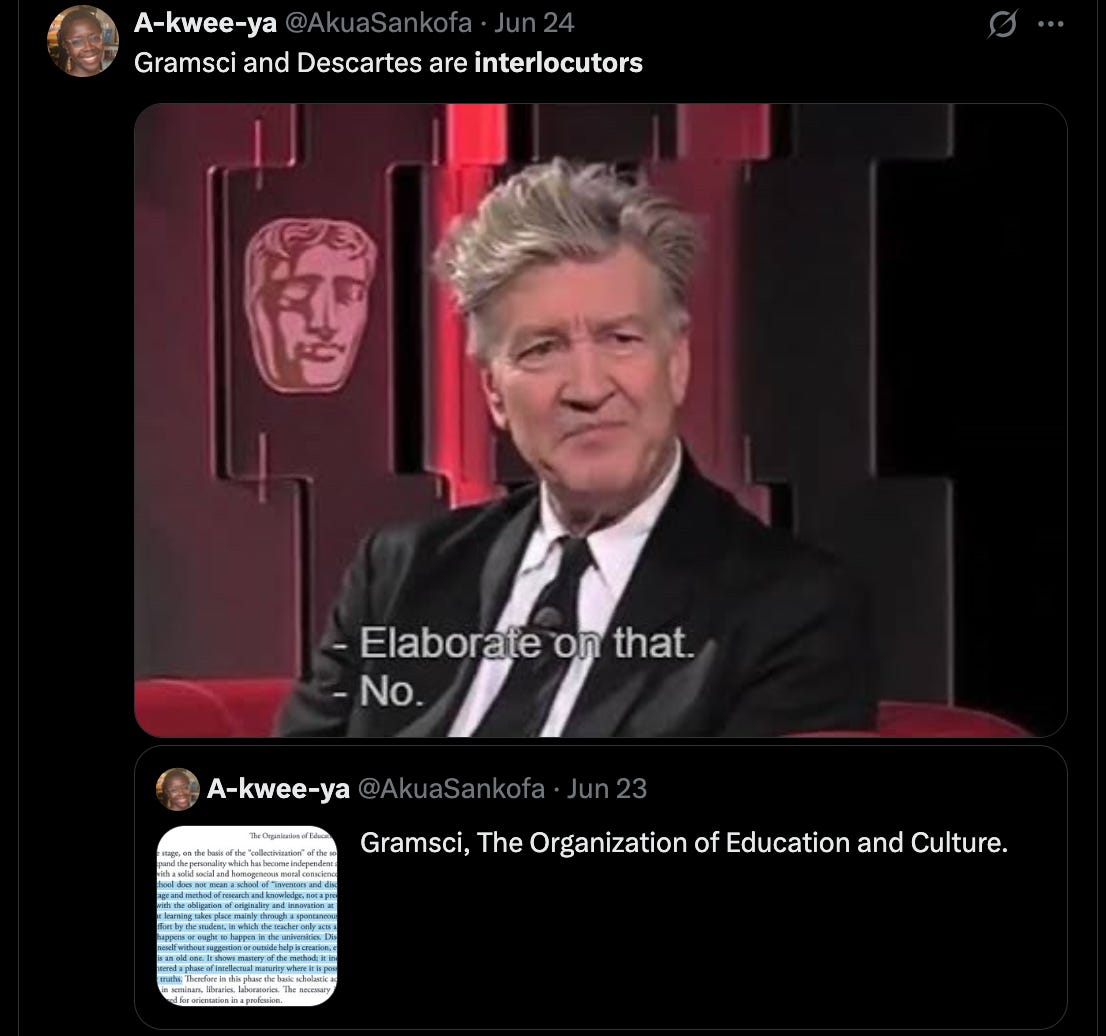
I said I wasn’t going to elaborate, but this has been the only thing on my mind for the last week.
So I decided to write about it.
This is all very preliminary, so I welcome any constructive feedback!
The Cartesian Myth, Versus Descartes’s Method
I came to René Descartes through David Bessis.
Earlier this year, I read Bessis’s Mathematica, a book about mathematical intuition, curiosity, fear, and the strange ways that people learn—or fail to learn—how to think with themselves. Bessis kept returning to the same simple proposition: perhaps the people we call geniuses are not aliens. Perhaps they are not the owners of some rare substance that the rest of us can only admire from a distance. Perhaps they are people who found, cultivated, and kept practicing a method that most of us were never shown.
One of the people Bessis brings into this conversation is Descartes. That sent me to Discourse on Method expecting, vaguely, the Descartes that public history had made available to me: mind-body binaries, cold reason, a man who supposedly wanted to sever thought from life and build a universe out of abstraction. Instead I found someone beginning with what feels like a nearly commonsense observation:
“Good Sense is, of all things among men, the most equally distributed.”
By “good sense,” Descartes means the power to judge correctly and distinguish truth from error. The differences between people, he says, do not necessarily arise because some people have more reason—interchangeable with good sense—than others. Instead, they arise because we conduct our thoughts along different paths and do not hold our attention on the same things.
“For to be possessed of a vigorous mind is not enough; the prime requisite is rightly to apply it.”
I had to pause here…
This does not sound to me like a philosophy of genius as inherited exceptionality. In fact, it sounded to me like Descartes was making a claim that could be much more radical than it has been allowed to be: human beings broadly possess the capacity for reason, but not everyone is given the conditions, the time, the confidence, the training, the examples, or the permission to develop it.
Descartes is careful not to cast himself as naturally superior. He says plainly that he did not think his mind more perfect than other people’s.
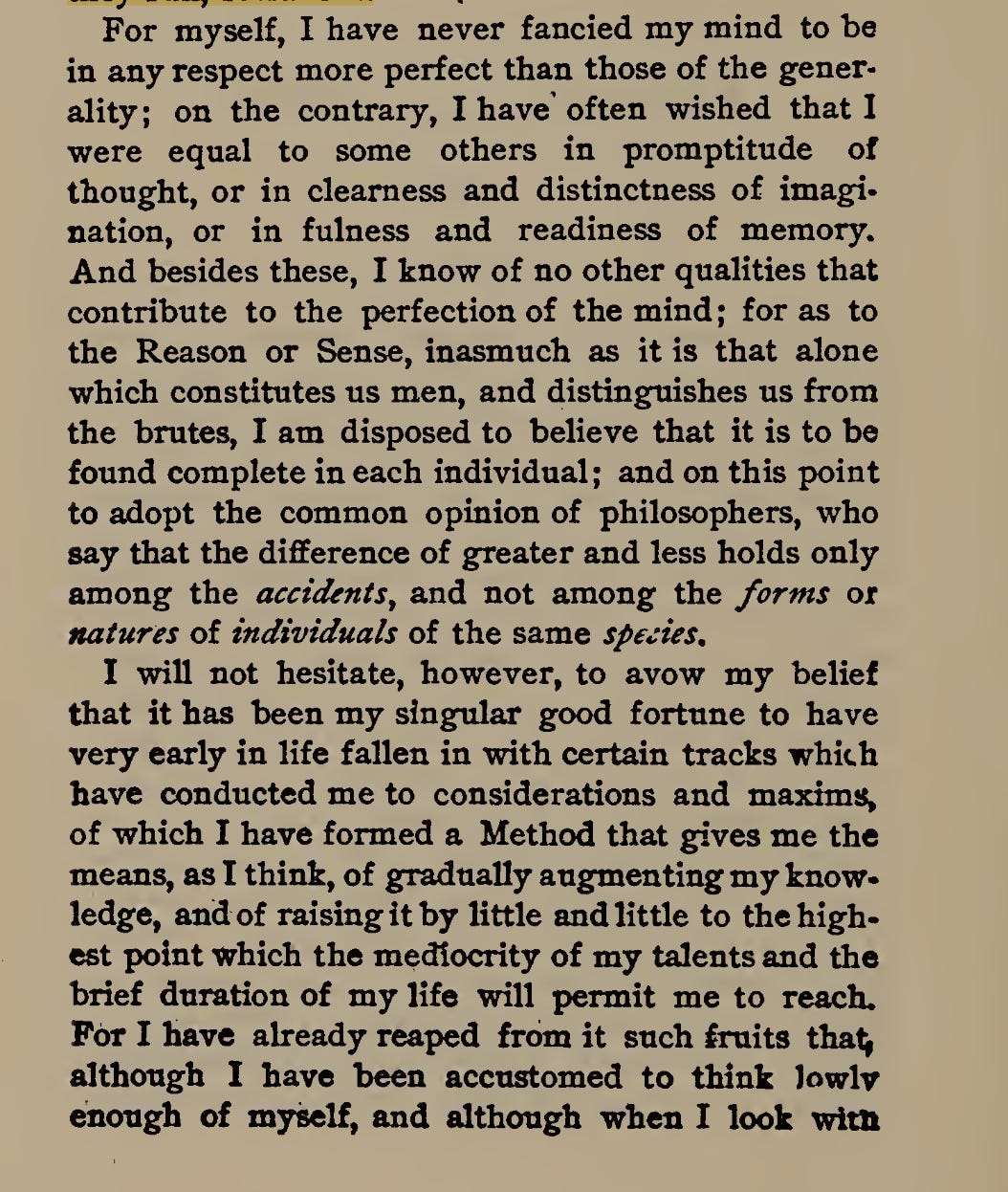
But what he believed he had found was a set of “considerations and maxims” that allowed him to increase his knowledge.
In other words, his “genius” was actually the result of a faithful application of method.
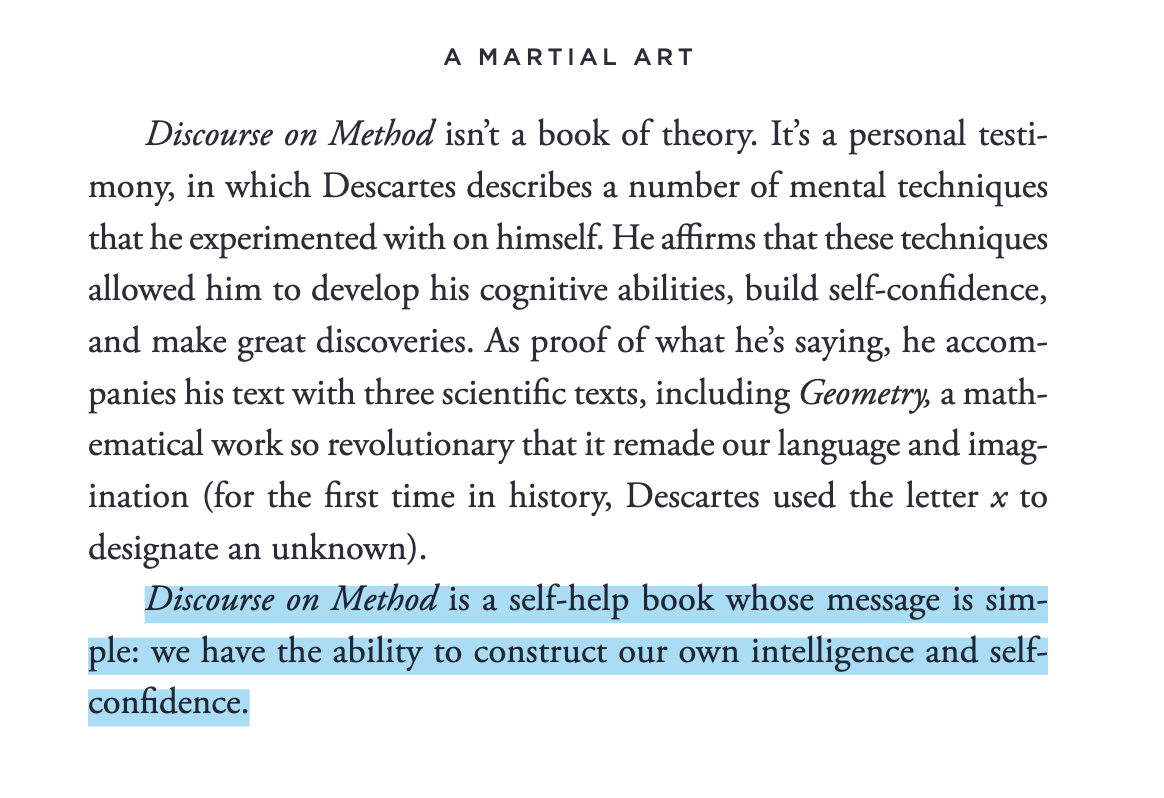
That distinction between genius and method is at the heart of Bessis’s critique because we are constantly encouraged to explain people’s capacities by turning them into pseudo-magical exceptions. Einstein must have had a special brain. Gauss must have been born with a different kind of mind. Descartes must have possessed a unique faculty inaccessible to ordinary people.
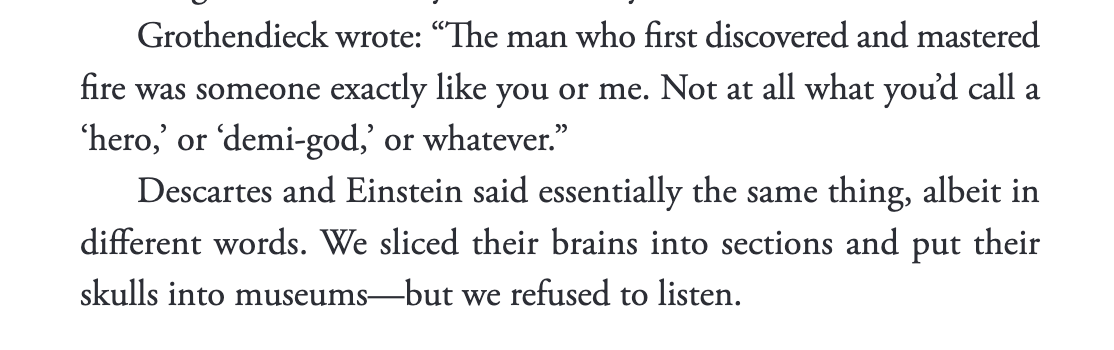
Once we say that, we no longer have to ask the more dangerous question: what did they actually do? What habits did they develop? What conditions enabled them to keep looking when other people were trained to stop? What would happen if those conditions were widely available?
Knowing History Without Knowing a Science
One of the things that struck me most in Descartes’s earlier Rules for the Direction of the Mind is his distinction between knowing what someone else has discovered and being able to discover. Under Rule III, he writes that someone could know all the proofs other people have created and still not become a mathematician. Without the ability to resolve difficulties, such a person has acquired “the knowledge not of a science, but of history.”
Read that again.
To put it in simpler language: just because you can repeat shit, doesn’t mean you know shit.
In the brief autobiographical account that Descartes includes in Discourse on Method, he describes leaving behind the hope that inherited learning alone would give him the certainty he wanted. But he didn’t retreat inward to conjure up a certainty that was innate. Instead, he learned from mathematics, travel, conversation, observation, and what he called “the great book of the world.” He observed courts and armies. He spoke with people of different conditions. He paid attention to what was happening in the world, and to the ways he interpreted it.
So, in leaving the university, he did not retreat from the world in order to think. He just wanted to stop the world from thinking for him.
What his adventures taught him was that knowledge has to become active in a person before it can be personally claimed. It has to become something you can work with, test, extend, and use to encounter the unknown.
What I’m trying to get at is this: Descartes’s method is often presented as this sterile process, and Cartesianism as a discipline seems to assert epistemological certainty in a way that sidesteps the individual’s process for knowing.
In actuality, Descartes—the Descartes I encountered, and the one Bessis discusses—was much more concerned with providing readers with an orientation toward thought rather than a set of beliefs that they had to uncritically internalize.
And his advice was quite simple:
Do not accept a claim just because it is old, prestigious, repeated, or agreed upon by a crowd.
Do not confuse the fact that you have encountered a proposition with the fact that you understand it.
Do not treat a sensation, a memory, a social consensus, or your own first interpretation as beyond examination.
But also: do not stay in doubt forever.
When certainty isn’t available but action is demanded, use the most probable judgement to guide your conduct. Be firm in action: follow the chosen course with the same resolution as if you were certain, so as to prevent endless reversals of your decisions.
The Limits of Intellectual Autonomy as a Private Escape Hatch
Even though I deeply enjoyed learning a method for navigating [gestures wildly] all of this, I kept feeling a tension while reading Descartes.
He provides a method for intellectual autonomy, but he does not seem to consider how to make intellectual autonomy socially available. In fact, he is quite cautious about any attempts to remake public institutions. In Discourse, he compares political and social arrangements to old cities: irregular, imperfect, sometimes ugly, but dangerous to demolish all at once. He is willing to rebuild his own house—his inherited opinions, his habits of judgment, his intellectual foundations—but he does not imagine himself rebuilding the city.
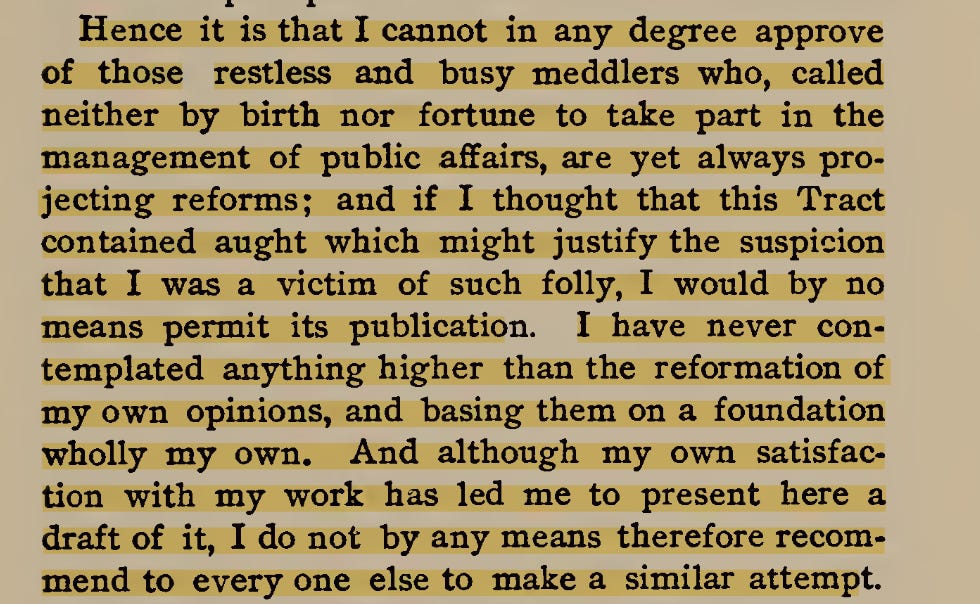
There are understandable reasons for this. He is writing in the seventeenth century. He is not a revolutionary theorist of mass education or collective liberation, and he is not living in the kind of revolutionary conditions that would even facilitate a broader conversation about how to democratize such a process. Hell, if anything it might’ve been the opposite!
Descartes is attempting to secure, for himself, a way out of intellectual dependence in a world where truth is often settled by tradition, authority, custom, status, and theology.
For me, as someone who has continually struggled against the very same things, even in spaces that are positioned as “progressive,” his method is a welcome addition to my repertoire. Especially because it does not require me to trust in anything except for my own ability to arrive at certainty. And after dealing with posturing and gaslighting in spaces that have attempted to convince me to accept an imposed reality, I really like the idea of releasing myself from needing other people’s permission to establish intellectual sovereignty.
But I cannot help reading Descartes from the question that comes afterward: what happens when the city helps produce the very confusion that the individual is trying to escape?
What happens when the problem is not merely that people have failed to apply their good sense? What happens when social institutions are organized in ways that unevenly distribute the conditions for leveraging one’s good sense?
The most devastating part of Bessis’s account about “secret math”— the living intuition, images, sensations, experiments, and inner movements through which mathematicians actually come to understand the symbols, proofs, rules, and formal demonstrations which comprise “official math”—is that this method is quite possible for anyone to learn. But the problem is that it is largely not taught. People may discover fragments of it by accident, through personal history, through unusual encouragement, through play, through stubbornness, or through the sheer luck of having enough time and safety to stay with a question. Others never encounter it at all. Then the resulting gap in competence is explained as proof that some people were always meant to understand and others were not.
But the fact that some people have been allowed to cultivate a capacity does not prove that the capacity belongs only to them.
Bessis does briefly say that mathematics is “an instrument of power and domination.” But he does not really pursue the political-economic question that opens up from there: what if the failure to teach people how to develop intuition is not merely a pedagogical mistake? What if it is bound up with a social order that benefits when creativity and mathematical intuition appear scarce, private, and biologically predetermined?
A society organized around hierarchy cannot be neutral about the widespread development of people’s ability to name the conditions of their lives, trace causes, challenge official explanations, compare what they are told to what they experience, and collectively imagine alternatives.
That is why in oppressive societies, institutions are generally organized around reproducing the conditions which stabilize the social order. In these societies, some children are given spaciousness, resources, confidence, rich language, intellectual risk, and the expectation that they will become people whose judgments matter, while others are given narrowed pathways, disciplinary surveillance, memorization, and preparation for roles in a workforce which actively disincentivizes creativity.
I don’t want this be read as me suggesting that working-class students are incapable of thought until someone saves them. Because it is the opposite. My point is that people already possess capacities that are systematically undernourished, mistrusted, redirected, or rendered invisible.
Gramsci’s Answer: Socialize the Conditions of Discovery
This is where Antonio Gramsci enters for me—as someone who attempts to answer the question Descartes leaves behind.
Descartes gives an account of why merely received knowledge is insufficient. But he is uninterested in the question of what kind of schooling could allow everyone to acquire the power Descartes had to laboriously construct for himself.
Gramsci’s answer, in “The Organization of Education and Culture,” arrives in the form of the unitary school: a common school of general culture that would replace the division between elite formative schooling and vocational schooling for those expected to occupy subordinate functions. The point is to prevent class destiny from appearing as aptitude—to stop a child’s future from being narrowed before they have had the chance to develop the general capacities needed to judge, orient themselves, and participate in social life.
The part of this vision that interests me most is what Gramsci calls the creative school: the final phase of the unitary school, when students begin to use the intellectual tools and shared formation they have acquired more independently.
This is not a school for manufacturing prodigies. Gramsci says the creative school does not mean a school of “inventors and discoverers.” It is “a stage and method of research and knowledge,” where the student is incentivized to investigate, gather information, develop judgments, and orient themselves toward a future profession.
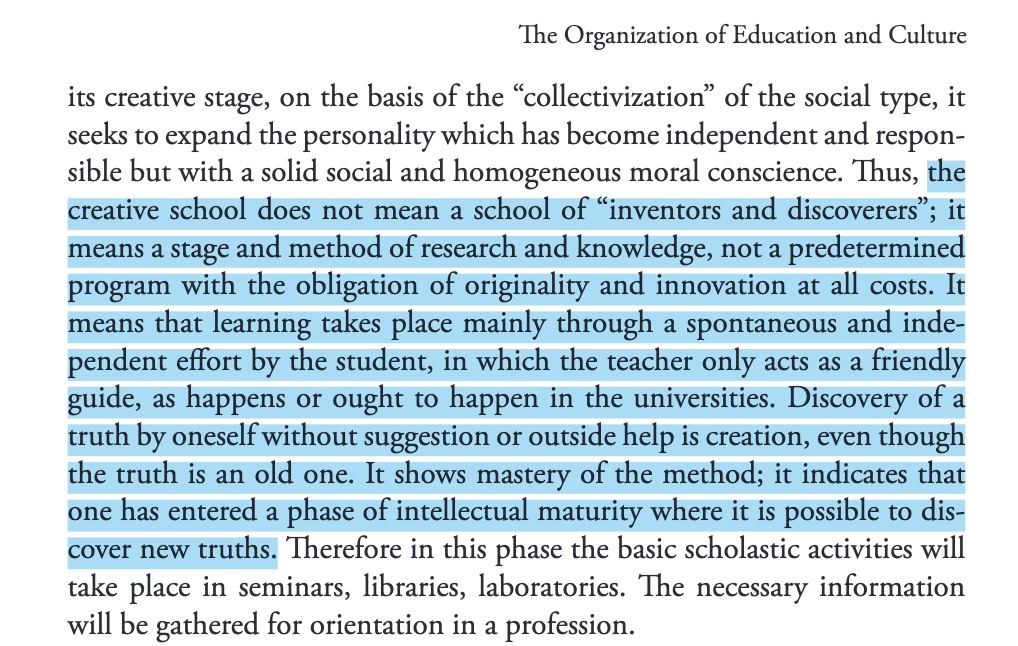
Novelty is not the point. Cultivating people who can enter a question actively rather than merely receiving its approved answer, is the point. The point is for students to arrive at a stage where learning happens through their own “spontaneous and independent effort,” while the teacher acts as a “friendly guide.” And then comes the line that has stayed with me:
“Discovery of a truth by oneself without suggestion or outside help is creation, even though the truth is an old one.”
That line feels like a direct parallel to what Descartes names around rejecting inherited opinions, and establishing one’s own relationship to certainty. Someone can receive a truth from another person and repeat it accurately. But when they arrive at it through their own activity of thought, they have not merely acquired a piece of information. They have demonstrated a capacity. They have shown that they know how to independently move through a question, distinguish what matters, and reach a conclusion. The truth may be old, but their relation to it is new.
Gramsci does not imagine this independence emerging from nowhere. The creative phase comes after a formative process in which students have acquired shared intellectual tools, habits of study, and a common social-moral ground. He calls the creative school “the consummation of the active school.” Earlier schooling has a leveling and disciplinary function; it establishes a common basis from which students can eventually become more autonomous. Then, on the basis of what he calls the “collectivization” of the social type, education can expand the personality that has become “independent and responsible.”
Gramsci unitary school is not one that tells students what to think more efficiently. He is trying to imagine an educational order in which people can become capable of thinking with and through one another without surrendering their own judgment.
This is also why Gramsci’s educational vision cannot be separated from the transformation in socio-economic conditions that he envisioned. A cultural reform might be necessary, but if it leaves people’s social and economic position unchanged, that cannot fully democratize intellectual life.
Additionally, if liberation is imposed from above by people who claim to possess the correct analysis, but ordinary people are not equipped to investigate, criticize, revise, and remake the world for themselves, then the old relation of domination has not disappeared.
And that’s why attempts by “well-meaning” educators in capitalist societies to apply Gramsci’s—or Freire’s—models continue to hit a wall. I also feel like there are some “organizers” out there who need to hear this…
A child cannot be expected to discover the joy of inquiry under conditions of hunger, exhaustion, insecurity, overcrowding, humiliation, or a future already narrowed by class position. The school is not a floating island. It is part of a larger social world, which has to transform first.
Descartes’s method is an individual escape from intellectual capture, but Gramsci’s unitary school is an attempt to make the conditions of that escape public—and, eventually, to make escape less necessary in the first place.
Why This Matters To Me
This is very vibes-based, but I sincerely believe that everyone has genius in them. I mean this literally: every single person in the world has genius within them.
I do not mean that every impulse is automatically genius merely because it belongs to someone. I mean that every person may contain capacities whose development would make the collective more capable, more beautiful, more perceptive, and more alive.
Yes, some people can solve “impossible” mathematical proofs, and draw entire city-lines from memory. But genius can be more subtle than that. Some people can hear things in birdsong that other people cannot. Some people know how to make a sick neighbor feel less alone. Some can walk into a room and leave people more vibrant without ever telling them they are special. Some can jump incredibly high. Some can bring a hidden tension into language. Some can cultivate food. Some can make children feel safe enough to become curious again. Some can organize a group of people who have been taught to distrust one another and help them recognize that they have a world to build together.
I think part of why people resist this idea is they are afraid that if everyone is special, no one is special.
I think that is backwards.
The belief that only a few people can be extraordinary is a scarcity logic. It imagines brilliance as a fixed quantity, which secures its value through its exclusivity.
Like genius is some luxury item.
Therefore, for such people: if someone else receives more recognition, I receive less; if more people become capable, my own capacity becomes less meaningful.
But I do not think that human development works like a shrinking pie. In fact, one person’s genius can make room for another person’s genius to become visible. Historically, individual and group discoveries have helped to expand the field in which another person discovers. One person’s cultivated perception can become a resource for others.
If there truly is a dialectic between the individual and the collective, it behooves us to imagine conditions for social transformation which do not require us to hope and pray that a few special individuals rise up to the occasion.
We have to be willing to believe that the constituent elements for liberation are present in all of us.