Lessons on Routine
Or, on the inevitability of loops and the joys of embracing them

I recently realized that what I used to call “freedom” was actually a set of self-punishing routines, and what I used to call “boring” was my body asking for stability. A movie I watched during a period of intense caretaking—“The Smashing Machine,” of all things!—provided the symbol that let me see this clearly, crystallizing heretofore unspoken experiences into words, sentences, and eventually this essay on routines as a form of self-tending and reacquaintance with my body, which I am sharing below.
For the sake of clarity, I’ll post my (much shorter) commentary on “The Smashing Machine” as a separate post. But here goes!
How I Changed My Mind About Changing My Mind
I used to believe that routines were just not my “thing” because they were “boring”. I figured with my particular cocktail of neurodivergence that I would be doomed before I even started a routine, even though I would still push myself to start them. Fitness, nutrition, writing, creativity, cleaning, productivity—if it has a name, I’ve probably attempted it. So in many ways, that history made sense.
But something shifted for me recently, and because of that I believe I have completely transformed my relationship with routines. Routines no longer feel imposed or deadening. They feel like inevitable — dare I say, exciting? — expressions of who I am now.
The change didn’t start with discipline, with me pushing myself through unappealing practices. Nope, it started with belief.
On the broadest level, I realized that a belief is not reality — it’s something I have accepted as true. I am the determining factor in whether something lands as “true” for me. That meant I wasn’t actually a prisoner of my beliefs. If I could accept one story about myself, I could also accept another.
This felt like moving a load-bearing wall in my internal architecture. In a physical house, that might make everything collapse. But in the mind, it doesn’t destroy as far as I can tell; it rearranges. New associations become possible.
It’s like learning that power = work ÷ time.
The words “power,” “work,” and “time” don’t lose their colloquial meanings when you take a physics class— but once you know the equation, they suddenly light up in relation to each other. A new structure appears.
The same thing happened when I realized I could change what I believed about who I was.
The whole point, in other words, was that in order to change a belief, I first had to believe that beliefs themselves were changeable.
And I have known this for a while, at least since my first physics class. But it seems that after starting grad school, I went on a journey of strategic forgetting. Thankfully, this knowledge returned to me and once it did, things started shifting without effort.
I began eating salads (wild for me). I walked outside barefoot. I played pickleball. I fantasized about being a drummer at a massive concert — despite never having touched a drum. Changing how fixed I thought I was created a new foundation that my body and behavior could stand on.
That’s when I returned to my old belief that routines were “boring.”
Here’s what that word had been hiding.
Belief, according to Merriam-Webster, is:
1. a state or habit of mind in which trust or confidence is placed
2. something accepted or held as true
3. conviction in the reality of something
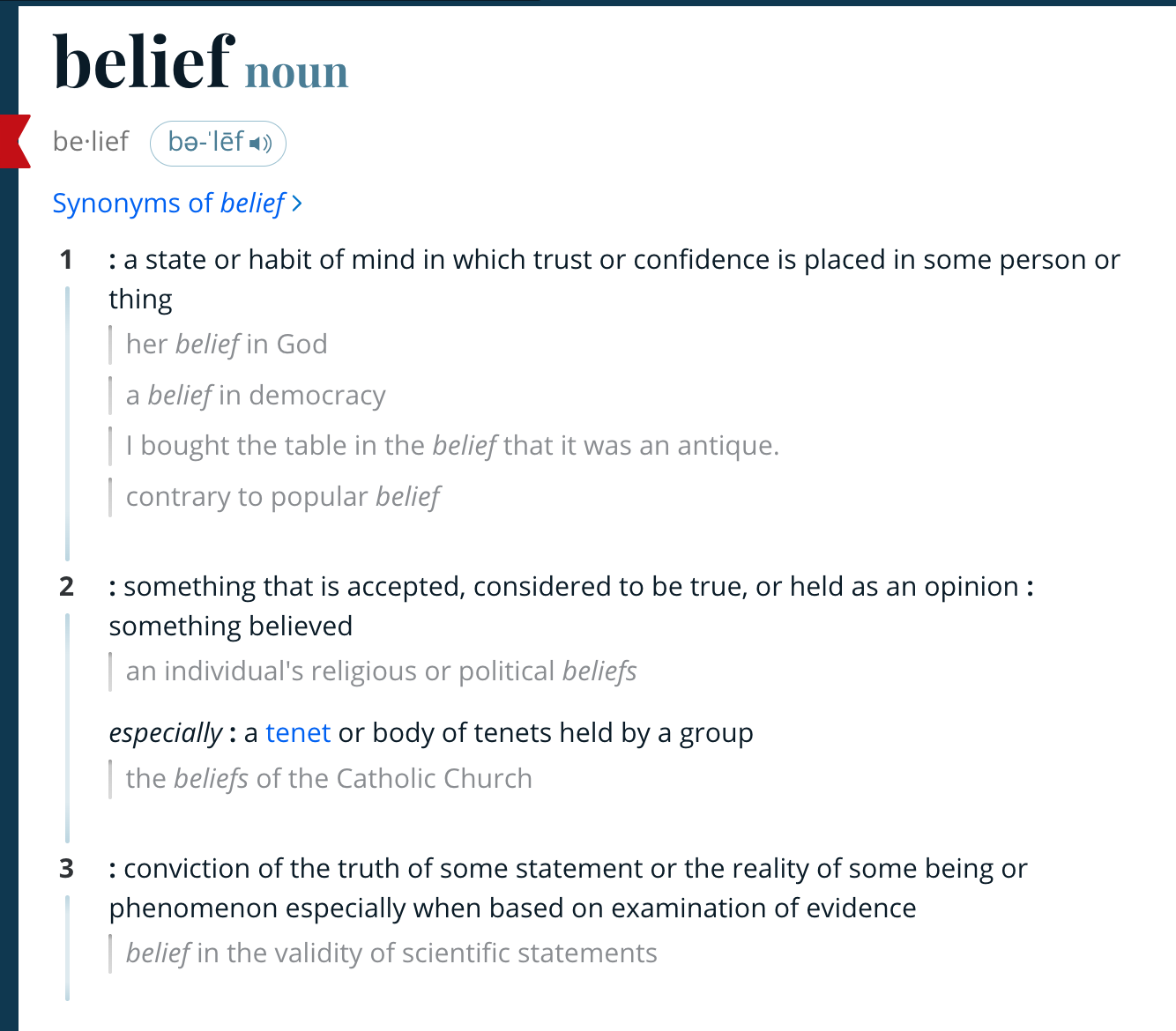
I realized I had been unconsciously storing belief alongside trust, true and reality.
So if I believed something about myself — “I’m not a routine person” or “I hate discipline”— it felt like an objective description of the world, not a story I had agreed to.
The same thing was true of the word “true.”
“True” can mean in accordance with fact. But it can also mean aligned, accurate, faithful, properly fitted, even logically necessary.
Something can be “true” because it matches the world — or because it matches the system you’re trying to live inside.
That distinction changed everything for me.
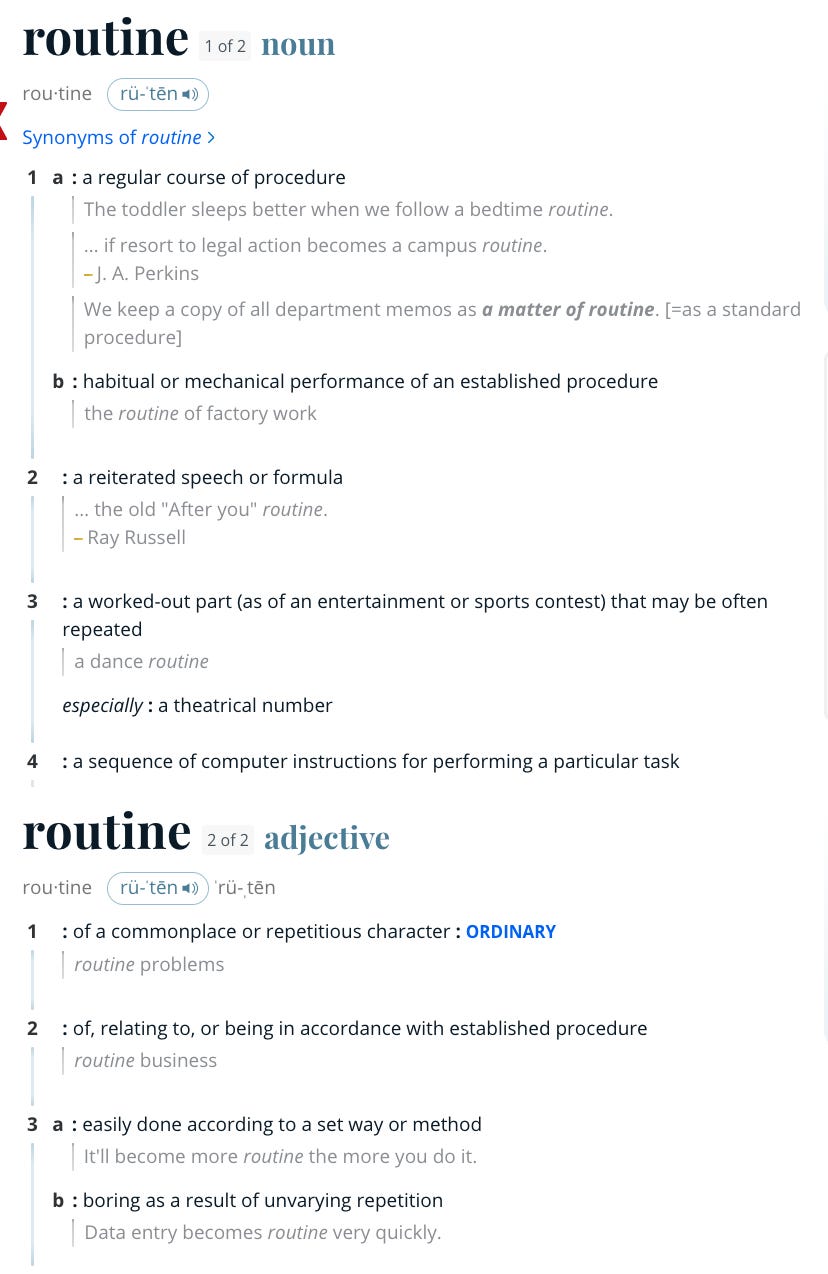
So when I looked at the word routine, I stopped seeing “boring” and started seeing something else.
Routine doesn’t just mean repetition. It could mean a path. A course. A sequence that produces a result.
A routine is simply a worked-out pattern that you can repeat when you want the same outcome again.
What I had been afraid of wasn’t repetition.
It was what happens when chaos stops — when there’s no drama, no collapse, no crisis to organize myself around.
Once I saw that, routine stopped feeling like a cage.
It started feeling like a way to choose who I become.
Breaking free of freedom dysregulation
One of the first things I noticed is that what I had called “not having a routine” actually had a very clear sequence.
It’s just that the outcome introduce more friction into my life, which I decided must be what freedom looks like.
For example: I would avoid making any kind of intentional plan the night before. I’d wake up dysregulated and hungry with no idea what to eat. Because I hadn’t done the “boring”1 grocery shopping two days earlier, deciding what to eat would feel overwhelming, so I’d stay in bed while my hunger escalated.
Eventually I’d hit feral hunger and go out to eat something with dairy — ALWAYS something with dairy, even though I’m lactose intolerant. I wouldn’t have lactase pills on me, or I wouldn’t want to wait to get them. So I’d eat anyway, knowing exactly what would happen next.
Pain. Exhaustion. A legitimate excuse to do nothing.
A self-induced lactose crisis was my get-out-of-jail-free card. I’d collapse, recover for days, and call it rest.
It looked like chaos. —>
It was actually a routine.
The Gastronomic Dysregulation Loop
Avoid “boring” grocery shopping—>Wake up hungry with nothing to eat—>Induce lactose crisis (pain, exhaustion)—>Excuse for inaction—>Pass out & recover (repeat as necessary)
Recovery was real — and it was also punishment disguised as escape.
Once I saw that pattern, I started seeing versions of it everywhere in my life, especially in relationships.
I called myself the “hopeful martyr,” and the loop looked like this:
The Hopeful Martyr Loop
A partner/loved one violates an agreement (I am hurt)—>I fantasize about their “true” kind core—>I empathize with their fear of abandonment, while downplaying my own—>I take responsibility for repair, even when they are resistant (secretly I’m the one afraid of being abandoned)—>Temporary calm—>New/old violation occurs (cycle repeats)
Different content. Same structure.
In both cases, I was using familiar suffering to avoid the terror of choosing something different.
These loops weren’t cruel. They were loving and well-intentioned…just badly aimed. They were the only way I knew how to give myself something that felt like consistency.
Eventually, though, I got tired of them and decided to give myself the real deal.
I bought lactase pills in bulk and put them everywhere. I stopped excavating other people’s rot. I revoked access. I showed up to pickleball. I went to craft nights. I walked 10,000 steps no matter my mood. Most importantly, I stopped outsourcing my internal check-in.
Some of what I tried didn’t work. Some of it was embarrassing. Some of it failed completely. But for the first time, I was intentionally testing new sequences instead of replaying the old ones that I thought were “chaotic”.
And my body noticed.
I no longer needed the adrenaline rush of dysregulation resolving itself. I learned, through slow experimentation, that my nervous system thrives on rhythm and predictability. Which meant I could build the types of patterns I can trust, instead of running the same old tired loops.
Routine stopped being the enemy.
It became a tool.
Now, when I feel off, I can usually trace why. I know what I ate, how I slept, moved. What I ignored.
Routine isn’t boring anymore. It’s just a set of instructions I can repeat when I want a certain outcome. And for now, that’s not restriction.
That’s agency.
Conclusion
Someone recently told me I was very disciplined, and suggested that I didn’t need to restrict myself — that I deserved a cheat day because I stop eating after 6 p.m.
But I don’t experience this as restriction. Or maybe, restriction doesn’t feel as “bad” as I would have thought.
I know what happens to my sleep when I eat late. I know how my body feels when I honor its rhythms. So I make choices that support the life I want to live.
I don’t view it as punitive. It feels like intimate self-recognition and honoring.
It feels good to know what to expect from myself, and to follow through.
It feels wonderful to become someone I can rely on.
Routine, for me, is not a cage. It is a promise.
It is me saying to myself: “I have listened to my body. I know what I need. And I am willing to keep myself safe inside the life I’m building.”
And it feels like love.
“bore” as a verb can mean (among many other things) both “to weary by dullness or sameness” and “to force (an opening), as through a crowd, by persistent forward thrusting (usually followed by through or into ); to force or make (a passage)”. So even the word “bore” could use with new associations in my head! So routines can be wearisome, yes, but they can also forge—through persistence—a path. GOD I LOVE HAVING A BRAIN!!!